 UK Belles
 How to Judge an Incall Venue, Not Just a Listing
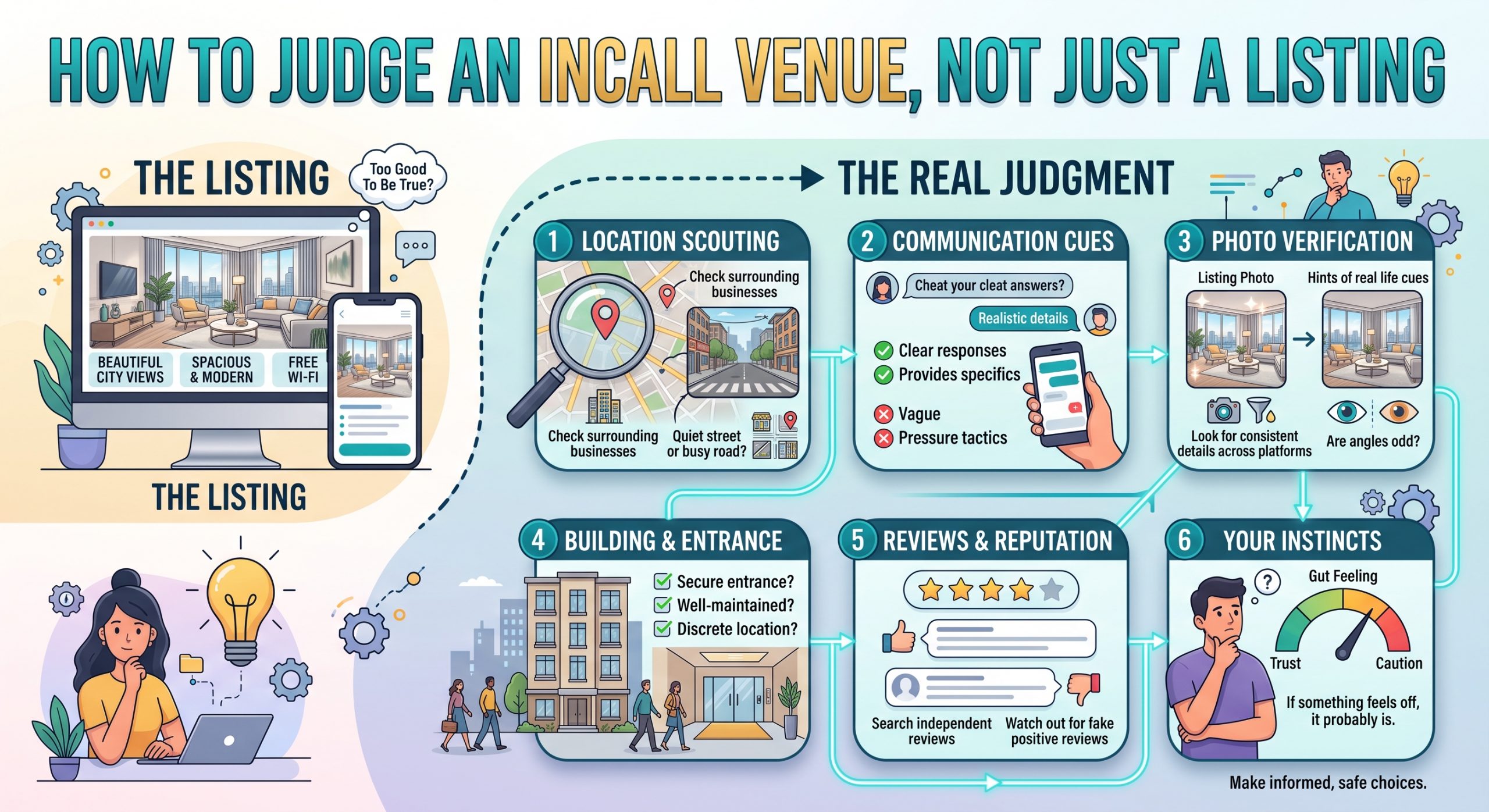
People will study a gallery for as long as it takes and never once look at the address. They compare photographs, read three descriptions twice, weigh one profile against another, then arrive somewhere they have never thought about and find out what they have actually booked.
The venue decides more of the hour than the listing does. It sets the tone before anyone has said a word, and unlike a gallery it cannot be edited.
Most guides to booking an incall focus on the person: how to make contact, what to say, how to behave. Very few say anything about the premises. This one does. It covers what a listing can and cannot tell you and how to read a venue’s website. It then walks through a well-run venue, a first visit, and why location matters more than most people think. It uses one long-established Manchester venue as a worked example.
Listing or venue: what each can tell you
What a directory can show
A good directory is a useful place to start. It gathers options in one place, shows photographs and descriptions, and lets you compare quickly. Some directories check that an advertiser is who they say they are.
What a directory cannot show you is the room. A profile tells you about a person. It says nothing about whether there is a shower, whether the room is clean, whether anyone will be there to greet you, or whether you will be able to park within half a mile.
What only a venue can show
An incall venue is a fixed place, with an address, opening hours and staff. That makes it checkable in a way a listing is not.
You can find it on a map before you go. You can read its facilities page and compare it with what you find when you arrive. You can see how long it has been trading. A venue that has traded for decades has built a reputation it cannot easily walk away from, and that changes how it behaves.
Before you book: reading a venue’s website
A venue’s own website tells you more than it means to. Four things are worth checking.
A real address and stated hours
Look for a full street address and a postcode you can put into a satnav. Look for opening hours that are specific, not “late” or “call for times”. A venue confident enough to publish exactly where it is and when it is open has nothing to hide about either.
Named facilities, not adjectives
“Luxurious” and “discreet” cost nothing to write. Specifics cost money to provide. Look for a facilities page that says what is actually there: how many rooms, whether each has its own shower, whether there is air conditioning, whether towels and toiletries are provided, whether there is a lounge. A list of real things is a far better sign than a paragraph of adjectives.
How long it has traded
A venue that has traded for years has kept enough customers to stay open, and repeat custom is the review that counts most. It also has something to protect, and that shows in how staff speak to you, how complaints are handled, and how quickly small problems are fixed.
How it tells you to get there
Most listings say discreet. Far fewer make it easy to arrive, which is a much better test because you can check it before you go. Look for parking information, public transport details and, ideally, a recommended local taxi firm. A venue that has thought about your journey has usually thought about the rest of your visit too.
What a well-run venue looks like inside
Reception and the introduction
You learn most of what you need to know at the door.
A well-run venue has somebody on reception whose job is to receive people. You are greeted, taken somewhere comfortable, and given a moment to settle before you are asked to decide anything. Nothing is rushed, because a place that is confident in what it offers does not need to hurry you past the front of it.
The alternative will be familiar to anyone who has tried a few. Nobody is there to receive you, and you make your choice standing in a hallway with your coat still on.
An unhurried introduction in a lounge matters for another reason. Chemistry is the one thing a gallery cannot show you. A venue that builds in a few minutes for you to find out has understood what it is selling.
The room
The gap between a good room and a poor one is mostly made of unglamorous things:
- Air conditioning. A closed room in a Manchester summer is warmer than people expect.
- An en-suite shower. Your own, not a shared bathroom down a corridor.
- Clean laundry and toiletries. Fresh towels and the basics, there when you need them.
- Somewhere to put your things. A chair, a hook, a surface that is not the floor.
None of that photographs well, which is exactly why it gets neglected. A venue that has spent money on the things nobody posts about has usually spent it on the rest too.
Variety is a quieter signal. Rooms that each have their own character, rather than three copies of one layout, suggest somebody furnished the place with care.
Cleanliness as a signal
Cleanliness is the one standard every visitor can judge for themselves, and it predicts the rest. Look at the reception area, the lounge and the shower. A venue that keeps the public parts spotless is almost always as careful with the parts you do not see.
Your first visit, step by step
A first visit to a venue is simpler than people fear. Knowing the order of things takes most of the nerves out of it.
- Check the details the day before. Confirm the opening hours and the address, and work out how you will get there and where you will park.
- Arrive on time. Early is fine. Late eats into your own time and throws out everyone else’s.
- Be greeted at reception. You will usually be shown to a lounge and offered a moment to settle.
- Meet and choose. In a venue with a lounge introduction, you meet the ladies working that day before you decide. Take your time.
- Settle the arrangements. Confirm the length of the visit and the rate before anything else happens, so there is no awkwardness later.
- Shower. Showering on arrival is standard courtesy, and a good venue makes it easy with an en-suite and fresh towels.
- Leave well. Dress, thank the people who looked after you, and leave the way reception suggests. A venue with a discreet rear entrance will tell you how to use it.
Etiquette that makes the visit better
Most of this is ordinary good manners. Be on time. Arrive clean and sober. Respect the boundaries you are given, and do not push against them. Treat reception staff with the same courtesy as everyone else. Keep your phone away.
A venue that runs well runs on these small courtesies. Regular visitors know it, and it is the fastest way to be welcomed back.
What the research says about touch
A major recent review, published in Nature Human Behaviour in 2024 by Packheiser and colleagues, covered 212 studies involving 12,966 people, 137 of them in a meta-analysis. It found that touch interventions reduced depression, anxiety and pain in adults. Touch from a health professional worked about as well as touch from someone familiar. The mental health benefits were smaller for healthy adults than for people with a clinical condition, but they were still there.
An earlier review by Moyer and colleagues, published in Psychological Bulletin in 2004, looked at 37 randomised studies of massage. It found that a course of massage reduced anxiety and depression by amounts similar to psychotherapy, and that a single session lowered anxiety, blood pressure and heart rate, though not cortisol.
The mechanism is less settled. A widely quoted 2005 figure claims massage cuts the stress hormone cortisol by 31%. A later and more rigorous analysis by Moyer and colleagues, in 2011, found the effect on cortisol was small and mostly not significant. The honest summary is that the benefit is well supported and the reason for it is still debated. The US National Center for Complementary and Integrative Health, part of the National Institutes of Health, takes a similarly cautious line on massage for specific medical conditions.
These studies are about therapeutic massage and touch, not about any particular kind of venue, and they make no claim for one. What they show is that touch is not a trivial human need.
The Touch Test, run in 2020 by Goldsmiths, University of London, with BBC Radio 4 and the Wellcome Collection, gathered responses from about 40,000 people in 112 countries. It found that 43% felt society does not allow enough touch, and that people with more positive attitudes to touch reported better wellbeing and less loneliness.
Why location matters: Manchester as a case study
Suburban venue or city-centre flat
In a big city the instinct is to look in the centre. For an incall visit, the suburbs are worth a look too.
A suburban venue can be easier to reach by car, easier to park near, and quieter to arrive at. There is no crowd on the pavement outside and no fighting through city-centre traffic. For visitors who arrive by air, a venue near the airport and the motorway network can be closer in practice than one in the middle of town.
Manchester is a good example. Tourism generated £12.7 billion of economic impact across Greater Manchester in 2023, according to Marketing Manchester’s STEAM figures, and its visitor survey found staying leisure visitors spent an average of £237 per person per day. Manchester Airport handled 32.1 million passengers in 2025, the third-busiest airport in the UK after Heathrow and Gatwick.
Getting to Northenden
Northenden sits about five miles south of Manchester city centre, on the south bank of the Mersey. It is close to the M56 and the M60 and to Princess Parkway, and Manchester Airport is about four miles to the south.
It is an old place. It appears in the Domesday Book of 1086 as “Norwordine”. Palatine Road, which opened in 1862 with a bridge over the Mersey according to Manchester City Council, became its shopping street. Northenden became part of the city of Manchester in 1931.
That mix of an established village centre, a main road and fast links to the airport and motorways is exactly what makes it convenient for a visit.
A worked example
It helps to see all of this in one place. Ladybirds, a Manchester incall venue in Northenden, was established in 1984 and is at 309b Palatine Road, opposite the Esso station.
Measured against the checks above, it does well:
- Address and hours: a full address and postcode, M22 4HH, and published opening hours of 10:30am to 6am every day.
- Facilities: three guest rooms, each with an en-suite shower, laundry and toiletries, plus air conditioning in every room, receptionists and a lounge where visitors are introduced to the ladies.
- Getting there: parking on nearby streets, a ten-minute drive from Manchester Airport by the venue’s own estimate, public transport details through Transport for Greater Manchester, and a recommended local taxi firm.
- Discretion: a separate rear entrance from Mill Lane, open from 10:30am to 7pm.
- Track record: more than forty years of trading.
Whether or not you go there, it is a useful picture to hold in your head while you read somebody else’s website.
A quick venue checklist
| Check | What good looks like |
| Address | A full street address and postcode, published |
| Hours | Specific opening hours, not “late” |
| Track record | Years, ideally decades, of trading |
| Facilities | A named list: rooms, showers, air conditioning, laundry |
| Reception | Somebody there to greet you |
| Introduction | A lounge, not a hallway |
| Shower | En-suite, with fresh towels and toiletries |
| Getting there | Parking, public transport and a taxi recommendation |
| Discretion | A considered entrance and an unhurried exit |
| Cleanliness | Spotless public areas |
Frequently asked questions
What does incall mean?
An incall is a visit to the provider’s own premises, such as a venue or a private flat. An outcall is the reverse: the provider comes to you, at a hotel or at home. An incall venue offers a fixed, checkable place with its own facilities.
How do you spot a poorly run venue?
Look for the absence of the basics: no published address, vague hours, a facilities page full of adjectives but no specifics, nobody on reception, and no shower of your own. Any one of these is a warning. Several together is a reason to go elsewhere.
Do I need to book ahead?
It depends on the venue, so ask when you call. Where a venue introduces visitors in a lounge, you meet the ladies working that day when you arrive. Many venues publish a daily rota on their website, and checking it saves a wasted journey.
Is a suburban venue better than a city-centre one?
It can be. A suburban venue near the motorway network is often easier to reach by car or taxi, easier to park near, and quieter to arrive at than a flat in the middle of town.